Tuesday, December 28, 2021

NC State's Most Important Game Ever Scheduled


Tommy Burleson with a baseline hook shot over Bill Walton at jam-packed St. Louis Arena. (Ed Caram photo)


NOTE: If you enjoy reading "One Brick Back" and would like to help offset research expenses for stories such as this one, please make a small donation to the cause and help keep posts like this free of ads.

© Tim Peeler, 2021

Perhaps the most important—and widely anticipated—contest in the history of NC State athletics was a made-for-television men’s basketball game between the Wolfpack and seven-time defending NCAA champion UCLA, played in St. Louis on Dec. 15, 1973.

As those two schools, which share little common athletics history, prepare to play in Tuesday night’s Holiday Bowl in San Diego, here’s how two undefeated teams from the 1972-73 season drew up the most watched and eagerly awaited college basketball game in a decade, thanks to a handshake and contract drawn up in tiny Buies Creek, North Carolina.

Back then, the infinitesimal town in Harnett County was the home of coach Fred McCall’s Campbell (College) Basketball School, which not only drew thousands of young players from all over the country but also some of the most talented counselors and top coaching minds in business.

Norm Sloan, Jim Valvano and Kay Yow were among NC State’s contributions to the camp, spending their time teaching fundamentals in one of the many un-air-conditioned small college or high school gyms from Buies Creek to Lillington and all the backroad schools in between.

Bob Cousy, Dolph Schayes and Bill Sharman were among the first NBA players who came to lead camp. Michael Jordan, James Worthy and Ralph Sampson were among the big-name recruits who attended through the years, where discomfort took a backseat to superb instruction, all for a camper fee of $25 for the week (though prices did balloon by $4.50 after 15 summers).
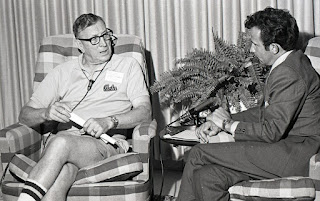


John Wooden interviewed by Don Shea. (Campbell University photo.)


The biggest name of all, however, was a quiet bespectacled little man who for 11 years was the roommate of former NC State, LSU and Appalachian State coach Press Maravich in one of the Campbell College dorm rooms: UCLA coach John Wooden.

Beginning in 1967, in the summer after he won the first of seven consecutive NCAA championships, “The Wizard of Westwood” was the most popular speaker and instructor during the week-long camp, shutting down the “Meatballs”-like atmosphere with his first spoken sentence.

First conducted in 1956, the Campbell school is purportedly the nation’s first residential basketball school for high school players. The following year, NC State coach Everett Case opened a similar residential camp at Raleigh’s Dorton Arena, modeled after the old high school coaches’ clinic he ran with Clifford Wells in Indiana. He, too, drew some of the most famous coaches, counselors and players in the country.

Conditions weren’t great. Carter Gym, which opened the same year as McCall’s first basketball school, held less than 1,000 spectators, every one of which was needed for the wildly popular nighttime games between college players who served as camp counselors. (Only once did they let a high school camper join in—and none of them could stop 15-year-old Pete Maravich.)

The court was four feet short of regulation, which made Pistol Pete’s full-court passes and half-court shots only slightly less impressive.

Agreeing to Play

In the summer of 1973, the Campbell school was reaching the height of its popularity. Wooden, fresh off an 30-0 record and another national title, had not only agreed to be a counselor again, but he also allowed the small Baptist-affiliated school to confer upon him an honorary doctorate of humanities, something the celebrated college player and coach had declined many times through the years.

Wooden loved the quiet little town in the Sandhills. He said many times that he planned to move to Keith Hills Golf Club when he retired from coaching basketball. He would have done so, too, had his wife Nell not gotten ill and required the advanced health care she needed in Los Angeles instead of Buies Creek.

One thing he hadn’t really counted on was that the biggest challenge to his on-going college basketball dynasty would be just 40 miles up the road in Raleigh, where head coach Norman Sloan, who, like Wooden, was an Indiana basketball evangelist who was spreading the college game to the masses. Sloan, however, did it with homegrown talent in the form of center Tommy Burleson and forward David Thompson, with a little Indiana flair thrown in from Monte Towe and Tim Stoddard. The Wolfpack was 27-0 in 1972-73, but barred from playing in the NCAA Championship event because of minor violations in the recruitment of Thompson.

For years, Wooden owned national recruiting, famously landing Lew Alcindor from New York by beating out Wake Forest coach Horace “Bones” McKinney for his talents. To win his seventh title and ninth in 10 seasons, Wooden relied on the “Walton Gang,” led by center Bill Walton and forward Jamaal (nee Keith) Wilkes.

They finished the season with a 30-0 record, beating in the semifinals and in the finals at St. Louis Arena to remain on the top of college basketball’s heap.

It was just another reason college basketball fans felt cheated in the era when freshmen couldn’t play, dunks were not allowed and only one team per conference could participate in the NCAA tournament.

The game between the Wolfpack and Bruins was agreed to by the coaches and fully arranged by two of the most powerful men in basketball: NC State athletics director Willis Casey and UCLA athletics director J.D. Morgan, both of whom served on the NCAA Competition Committee.

Earlier in the year, Casey had successfully arranged the first nationally televised game since Houston beat UCLA in the Astrodome in 1968 when the Wolfpack traveled to Maryland on Super Bowl Sunday. The game was a smashing success and the national coming out party for Thompson, who tipped in a missed shot in the final seconds for a 72-70 win at Cole Field House.

They agreed to play the game in the middle of the country, at the same 19,200-seat St. Louis Arena where the 1973 semifinals and finals were played. (It wasn’t called the Final Four until 1978). ABC-TV agreed to televise it.

International Interest

Sloan wanted to make his team internationally famous, too. The U.S. State Department, a little over a year after President Richard Nixon’s historic trip to China, was looking for a college basketball team to tour Red China to play a series of exhibition games against top Chinese teams. Both the Bruins and the Wolfpack were among the teams invited to go. After UCLA declined, the Wolfpack accepted. The NCAA, however, refused to let Sloan and his team go because they were technically still on probation. The whole tour fell apart.
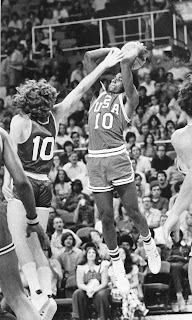
Thompson at the World University Games.
Instead, the basketball-loving people behind the Iron Curtain were introduced to one of the best USA Basketball teams ever assembled, as Thompson, Burleson and Sloan were all part of the squad that participated in the World University Games in Moscow in August, 1973, just 11 months after the Soviet Union’s disputed gold-medal victory at the 1972 Munich Olympics. The whole event was seen as the U.S.’s attempt to regain supremacy in international basketball competition.

The young American team – which also featured Indiana’s Quinn Buckner and Providence’s Marvin Barnes – began with an 11-game exhibition tour in Poland, Czechoslovakia and Bulgaria. In Moscow, Thompson was spectacular, leading the high-scoring, hard-running team to its first five wins by an average margin of victory of 81.2 points.

The team survived an on-court brawl with Cuba in its sixth game, then defeated Brazil and the U.S.S.R. to win the gold medal. By the end of the event, the Russian spectators were shouting Thompson’s name and giving him standing ovations every time he stepped on the floor, an amazing display of support during what was still a high point of the Cold War.

So it’s not an exaggeration to say that everyone in the world who cared about basketball wanted to know the outcome of the regular-season match-up between NC State and UCLA game.

Putting Their Streaks on the Line

UCLA entered the early-season game against the Wolfpack on a 78-game winning streak. State had won 29 in a row, the most by an ACC team since North Carolina’s undefeated national championship season in 1957.

The Bruins were ranked No. 1 in the nation, the Wolfpack No. 2. Some 40 million spectators were expected to watch the game, a half-decade before sports network ESPN began broadcasting as a cable television network.

The UCLA-NC State matchup was actually the second in a doubleheader, following a contest between St. Louis and Southern Illinois. Tickets for both games—$8 and $10 each—were only available by mail when they went on sale on July 1, and sold out within days.

The teams were not the same as they were the year before. NC State had to replace Joe Cafferky and Rick Holdt and UCLA had to replace Larry Hollyfield and Larry Farmer from their 1973 teams.

“It should be a tremendous game, but it should not be regarded as a settlement of last year’s issue,” Wooden said before the game. “We’ve both got fine teams back, but they are different teams. Last year is dead and gone.”

Sloan and his team were confident about their chances. Perhaps a little too confident, following a 32-point win over East Carolina and a 55-point win over Vermont, outcomes that made Sloan livid because he didn’t think his team played particularly well.

His mood changed as the trip to St. Louis approached.

“We are very relaxed right now,” Sloan said. “We had some problems playing our other games with this one ahead, but now everything is fine. It’s going to be an enjoyable experience for us. We’re not uptight about it; we realize the importance of it, but it can’t become too important. We’ve got too many other things in front of us.

“Win or lose this game, the thing that counts in our league is winning the title and the postseason tournament. I think it’s great that we’re playing. If you have two teams that can go for some freak reason through a season undefeated, they should get together and play.”

Sloan knew the game against the Bruins would be an understudy contest should his team win the ACC for the second year in a row and advance to the NCAA Tournament.

UCLA's Bill Walton in the 1974 NCAA semifinal game.
“The time we want to peak is in March,” he said. “That’s when I’d like to go undefeated – in March.”

The game was billed as a contest between differing All-Americans: UCLA’s Walton, unquestionably the nation’s best big man, vs. NC State’s Thompson, whose remarkable skills were often compared to Oscar Robertson, Julius Erving and Elvin Hayes.

The answer would be found, Sloan said, elsewhere on the roster.

 “I don’t think we will stop Bill Walton,” the coach offered. “But I also don’t think UCLA will stop David Thompson.”

Excitement was palpable from coast to coast as the game approached.

“I am glad we are getting an early shot at them,” Burleson said. “I think it helps to play the best and I play better against the strong teams. We’ll learn a lot from this one.”

Sloan had no problem telling anyone who would listen that this was NC State’s greatest team, because Thompson was healthy and more mature, Burleson was out to prove something and diminutive guard Monte Towe was ready to lead. Plus, the Wolfpack added two of the nation’s best junior college players, Mo Rivers and Phil Spence, to its lineup.

UCLA, meanwhile, had played well in a difficult season-opening win over Maryland, a game that went down to the wire, 65-64. It arrived in St. Louis riding a 78-game winning streak, the longest in NCAA history.

“The thing I remember the most about that game is just the build-up for it,” said Towe when he was a Wolfpack assistant under Sidney Lowe. “It lasted the whole summer because both of us were undefeated and unable to play each other the season before.”

Failure to Take Advantage

It appeared early on that the game would live up to the hype.

Walton—“Big Red” to the nickname aficionados—was overly excited in his first career game against 7-foot-4 Burleson. The two had a balky existence going back to the 1972 Olympic Trials, when Walton refused to participate in tryouts, saying he was already proven to be the best big man in the country, while Burleson outplayed the rest of the competition to become the youngest player on the Olympic roster.

In the electric atmosphere, Walton picked up four fouls in the game’s first 10 minutes and was relegated to the bench for more than half of the opening period.
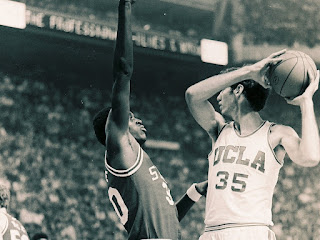
UCLA's Ralph Drollinger guarded by Phil Spence.
(Ed Caram photo.)
The Wolfpack couldn’t take advantage of Walton’s absence. Thompson was called for traveling on several occasions early in the game and he became reluctant to drive against Wilkes. Making things worse, his high-pinnacle jumpshot just wasn’t falling.

UCLA reserve center Ralph Drollinger came in for Walton and roughed up Burleson late in the first half.

“It happened right at the end of the first half,” Burleson said. “He hit me with a forearm shiver right in the nose and top of the mouth. I played the second half with a broken nose and two missing teeth.”

Even though Sloan and his team led 33-32 at the half, there was an overwhelming sense among the sold-out arena that the Wolfpack was barely hanging on, while the Bruins were cruising without their best player on the court. Wilkes was picking up the slack in scoring—he finished with a game-high 27 points—and keeping Thompson under wraps.

“I thought we were a little cautious at first,” Wooden said. “Later, however, I knew I could bring Walton back any time from the bench. They (State) knew it, and that’s something to think about.

“I told our players if we could stay close until mid-way through the second half without Bill, I thought we’d be all right.”

So, with 9:54 remaining in the game and his team leading 54-52, Wooden inserted Walton back in the game. State tied the score on its next possession, but Walton led the Bruins on 10-point and nine-point scoring runs sandwiched between a lone Wolfpack basket over the next three minutes.

The last 10 minutes of the game were hardly a contest and the Bruins won going away, 84-66, extending its winning streak to 79 games and retaining its claim as college basketball’s most dominant program.

Lasting Impact

In the end, the arranged game could have been a source of embarrassment for Sloan’s newcomers at the top of college basketball. It could have affected how the Wolfpack played its ACC season or how it performed in the NCAA Championships.

It didn’t.

“When Walton got into foul trouble, we should have taken over the game,” Towe said. “Drollinger came in the game and did a number on us and Keith Wilkes did a great job on David.

“We just weren’t good enough to win that day. I think it helped us in the long run, because we knew if we played them again, we would be playing to win instead of looking at the name on the jersey.”
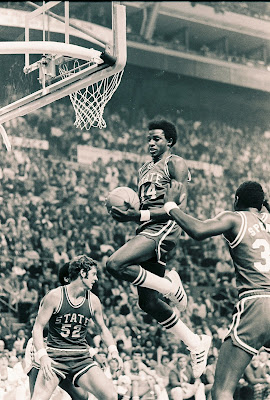
NC State's David Thompson vowed he would never play so poorly again.
(Ed Caram photo.)
There were some hard lessons to learn for the players and for Sloan, who recognized that he needed to take more advantage of his quick backcourt and solidify the play of his complementary players like Rivers, Spence and Stoddard.

“We really didn’t execute too well in the first game,” Thompson recalled. “That was the first time in a big game like that that we had been down and we didn’t handle it too well.”

The Bruins’ winning streak eventually ended at 88 (a record that still stands) when it lost at Notre Dame. Wooden and his team lost twice more before the NCAA Tournament. The Wolfpack, meanwhile, learned its lessons and kept getting stronger in a handful of tough games in the ACC season.

Nothing, of course, was tougher than defending its championship in the 1974 ACC Tournament, culminating with the 103-100 overtime victory against Maryland, still considered the greatest game in ACC history.

“I think by the time we played again in Greensboro, we were a more cohesive team,” Thompson said. “I knew I was never going to play that badly again. Usually in the big games, I played my best. We felt like they didn’t see the true NC State team. We wanted to redeem ourselves and we really wanted a chance to do that.”

Burleson, who was roughed up in the first game by Drollinger, believes the loss hurt the Bruins almost as much as it helped the Wolfpack.

“It allowed UCLA to be a little bit complacent in the second game,” Burleson said. “They just felt they were better than us. They probably were—in that game.”

The reason that the regular-season game was so important in the annals of Wolfpack history was that it took the high-flying Wolfpack down a notch and gave them motivation to set up a rematch. They got it in March, without having to travel outside its home state, winning the NCAA regional in Reynolds Coliseum and then taking a 90-minute bus ride to Greensboro.

There, in double-overtime, Thompson and Burleson ended the Bruins stronghold on college basketball in the semifinals, and Towe made sure the team did not suffer a letdown in the finals against Marquette.

Those wins might not have happened, however, were it not for the mid-December NC State-UCLA game, a contest of international acclaim drawn up in the sands of Buies Creek, North Carolina.


Saturday, November 27, 2021

Carter-Finley Stadium's Most Dramatic Victories


NC State quarterback Erik Kramer throws the game-winning pass to Danny Peebles against South Carolina in 1986.

NOTE:
If you enjoy reading "One Brick Back" and would like to help offset research expenses for stories such as this one, please make a small donation to the cause and help keep posts like this free of ads.

© Tim Peeler, 2021

When NC State bolted back from a nine-point deficit against arch-rival North Carolina Friday night in the final two minutes for a 34-30 victory, it completed one of the most dramatic and exciting comebacks in Carter-Finley Stadium history.

The immediate question was asked: Was it the most dramatic of the 224 victories the Wolfpack has posted in the 348 games it has played since the stadium opened in 1966?

I never like to talk in absolutes, but there few games can compare to the victory, which now gives State an opportunity to qualify for its first ACC title game ever and have the possibility to win its first championship since 1979.

The game that immediately came to mind for most was the victory over South Carolina on Nov. 1, 1986, when Danny Peebles caught a touchdown pass from Erik Kramer with no time left on the clock.

The difference is, that late-second win actually cost Dick Sheridan’s inaugural team a chance to win the ACC title, because Kramer was injured on the final play and had to sit out the next week, when the Wolfpack could have secured the ACC title with a win over Virginia.

Lefthander Cam Young started in Kramer’s place and the Wolfpack lost 20-16 on another last-second pass, in which Young’s potential game-winning throw was intercepted in the Virginia end zone.

There are some games that are close, against arch rivals, against national rivals, against state rivals and minor rivals.

Here are 13 games with exciting finishes that possibly could match Friday’s outcome, at least in terms of excitement, if not necessarily the importance of the actual win towards the ACC race or national significance.

Oct. 9, 1971: Trailing 15-14 with 22 seconds to play in a steady downpour, Wake Forest lined up to attempt a game-winning 52-yard field goal. The Wake kicker slipped on the attempt, and the ball squirted into the hands of NC State’s Bill Miller. As Miller ran down the sidelines for a touchdown, Wake Forest quarterback Larry Russell came off the bench to tackle the Wolfpack runner, who was eventually awarded the score. The Wolfpack won 21-14 and gave interim head coach Al Michaels his first career victory.

Oct. 6, 1973: Out to a 21-3 lead behind the leadership of quarterback Dave Buckey, NC State fell behind in the second half and needed a fourth-quarter, fourth-and-one touchdown by 1973 ACC Player of the Year Willie Burden to take a 28-26 victory over North Carolina that was a big part of the only ACC title of the Lou Holtz era, as the Pack won seven of its final eight games.

Sept. 20, 1975: With his team trailing No. 13 Florida 7-0 with less than four minutes to play, Wolfpack defensive back Dan Meier recovered a fumble on the Florida 38-yard line. On the next play, Dave Buckey hit Elijah Marshall on a post pattern for a late touchdown. Holtz sent sophomore Johnny Evans in as a fullback, and Evans took the pitch in for a two-point conversion to give the Wolfpack a much-needed 8-7 win. The victory came as an unexpected bounce back a week after the only home defeat of the Holtz era, a 30-22 loss to Wake Forest.

Oct. 4, 1975: With 12 seconds remaining on the clock, NC State’s defense stopped a North Carolina two-point conversion to hold on to a 21-20 victory during running back Ted Brown’s freshman season. Behind the running of Mike Voight, the Tar Heels put together a potential game-winning drive, going 64 yards on 13 plays. Voight scored on a one-yard plunge up the middle, but the conversion failed, thanks to a pass rush on UNC quarterback Bill Paschall by defenders Ron Banther and Tom Higgins. UNC-CH coach Bill Dooley charged after the game that an official saw an NC State defensive back hold a UNC receiver but intentionally opted not to call a penalty. “I’m going to sound like a sore loser, but I have to comment on our two-point conversion,” Dooley said after the game. “Our pass receiver (Brian Smith) was grabbed by the defender and pulled to the ground. This happened right in front of the official and he refused to call it. With him down, Paschall had no choice but to keep the ball. The play worked perfectly—State had three defensive backs on the other side of the field, but we just didn’t get the correct call from the official.” Lou Holtz said: “Our games with Carolina are some of the real classics.”

Oct. 1, 1977: Senior quarterback Johnny Evans engineered a 69-yard drive in the final two minutes of the game, scoring a go-ahead touchdown with 27 seconds remaining on the clock to give his team a 24-20 victory over Maryland, who entered the game with an ACC-record 21-game winning streak.

Nov. 1, 1986: With no time remaining on the clock, the Wolfpack had one last-ditch opportunity to beat visiting South Carolina, thanks to a Gamecocks penalty. Using a play literally drawn up in the dirt on the sidelines, future NFL quarterback Erik Kramer found dual-sport star Danny Peebles in the back of the south end zone on the Hail Mary throw to give the Wolfpack one of the unlikeliest and most dramatic victories in school history.

Oct. 19, 1991: Trailing Division I-AA Marshall 14-3 late in the fourth quarter, the 11th-ranked Wolfpack needed an 84-yard drive engineered by quarterback Geoff Bender—and aided by a couple of pass-interference penalties, along with a perfectly executed onside kick by Damon Hartman, who missed three field goals in the game—to pull off a comeback victory against the Thundering Herd. Marshall head coach Jim Donnan, the starting quarterback at NC State in the first game played in Carter Stadium in 1966, was disappointed with the officiating during the game. Afterward, he said, “I’m lower than a well-digger.”

Nov. 15, 1994: With his team trailing 18th-ranked Duke 23-7 in the third quarter, Wolfpack quarterback Terry Harvey hit wide receiver Adrian Hill with an 82-yard touchdown pass to begin a dramatic comeback. Harvey set up another touchdown with a 53-yard bomb to Greg Addis to set up a field goal, then hit a 2-yard pass to Mike McGuffie with 5:50 remaining to give the Wolfpack a 24-23 lead. After the game, Wolfpack fans tore down the goal posts in celebration of the win that propelled Mike O’Cain’s team into the Peach Bowl, where it beat Mississippi State 28-24 to cap a 9-3 season.

Nov. 22, 1997: A year after NC State and East Carolina renewed their rivalry in Charlotte, a sold-out crowd saw a close game that was tied 24-24 with less than a minute to play. Quarterback Jamie Barnette scored a go-ahead touchdown from the 1-yard line with 51 seconds to play and linebacker Clayton White returned an interception for 34 yards to finalize the Wolfpack’s 37-24 victory.

Nov. 1, 2003: Junior running back T.A. McLendon, hobbled with a leg injury throughout the game, exploded on a 38-yard touchdown run with just 23 seconds to play against Virginia, breaking a 37-37 tie between the ACC’s two highest-scoring teams. The Wolfpack scored again following the kickoff on a 26-yard interception return by Victor Stephens in the 51-37 victory.

Oct. 5, 2006: Quarterback Daniel Evans, making just his second career start, found wide receiver John Dunlap in the northeast corner for the second consecutive week to knock off visiting 17th-ranked Florida State 24-20 in a Thursday night contest. It was the final career victory for Wolfpack head coach and longtime Florida State coach Chuck Amato, who was let go after the Wolfpack lost its final seven games of the season.

Nov. 28, 2009: Russell Wilson threw four touchdown passes and Alan-Michael Cash blocked a field goal with four minutes to play as the Wolfpack beat archrival UNC-Chapel Hill for the third consecutive year. Wilson rallied his team from a 24-14 first-half deficit and dedicated the season-ending 28-27 victory to offensive coordinator Dana Bible, who had been diagnosed the previous week with leukemia. Bible watched the game from his hospital room at the UNC Lineberger Cancer Center in Chapel Hill.

Nov. 26, 2011: Mike Glennon threw a Carter-Finley record five touchdown passes and brought the Wolfpack, which had trailed 41-14 late in the third quarter, back for a 56-41 victory against Maryland. Glennon, who also scored a rushing touchdown, helped the Pack score 35 fourth-quarter points, completing the second-largest comeback in ACC history.

Saturday, November 13, 2021

When Wake Forest Banned Football After a 4-4 Tie with NC State


NC A&M's 1895 football team [photo: NC State Special Collections Archive.]

NOTE:
If you enjoy reading "One Brick Back" and would like to help offset research expenses for stories such as this one, please make a small donation to the cause and help keep posts like this free of ads.

© Tim Peeler, 2021

The NC State-Wake Forest football rivalry is the second longest continuous rivalry in college football, contested every year since 1910, through war, wind and woe.

What of the first meeting in the 114-game series, the only game between the two teams played before the turn of the 20th century? Surely, there is an interesting backstory to why these close neighbors played just once in 1895, not again until two games in 1908 and then continuously since 1910.

Indeed.

On Friday, Oct. 18, 1895—the day before the North Carolina College of Agriculture and Mechanic Arts (A&M College, now NC State) hosted Wake Forest at Raleigh’s Athletic Park—the faculty at Wake Forest announced that following the Saturday afternoon contest down in the state capital, the Baptist football team would no longer be allowed to leave campus to play games, effectively banning varsity athletics at the evangelical school.

“The faculty allowed today’s game in Raleigh on account of peculiar circumstances, but took the following action with reference to the future: That after Oct. 19th our students be allowed to play no match game of football except on their own grounds.”

In effect, that decision shut down football for the next 12 years at the Baptist-based school in northern Wake County, becoming the state’s second religiously based school to ban the sport. Methodist-affiliated Trinity (now Duke) had chased off its president, John Franklin Crowell, who introduced college football to the state in 1888, because of his devotion to and promotion of football as a premier form of physical activity. His replacement, John Carlisle Kilgo, immediately banned the sport at Trinity in 1894.

“I have uncompromising objections to the modern football contests,” said Kilgo, hired from South Carolina’s Wofford College.

Trinity did not reinstitute the sport until 1920, when it decided it could no longer tell its student body, many of whom had served in The Great War in Europe, that football was too dangerous for them.

The faculty at Baptist-affiliated Wake Forest agreed that football was in direct opposition to its Christian values.  As reported in The North Carolinian, a Raleigh publication of the day: “Wake Forest College steps into line with a rule forbidding students to play football except on the College ground. This may seem hard on the boys but in a little while they will know that it is not. Last year, 43 men were killed in the game in four months. Only 12 men were killed in Spanish bullfights in the entire year.” [NOTE: These numbers are unverified by any other published work.]

Football, of course, was still in its infancy, the rules still morphing from rugby into something vaguely resembling the game played today with the 61 rules established in 1876. It was unrelentingly brutal for the players who had little more protection than padded pants and shirts, with no helmets. Things got especially bad when Princeton’s popular blocking tactics of the 1880s evolved into “the flying wedge.”

Making things worse was the rule forbidding free substitution. Once a player was removed from a game, he could not return, which meant many of the best players who were hurt stayed on the field until they were unconscious and had to be carried off on a stretcher.

The game became so dangerous that President Grover Cleveland Alexander banned the Army-Navy game in 1893. Harvard banned football the same year following a bloody game with Yale that is often referred to as the most brutal game ever played. In 1894, the football rules committee banned all forms of wedge blocking.

Noted sportsman and future president Theodore Roosevelt wrote in the Dec. 23, 1893, issue of Harper’s Weekly: “The brutality must be done away with and the danger minimized…The rules for football ought to probably be altered so as to do away with the present mass [or wedge] play, and, I think, also the present system of interference.”

Most evangelical schools, like Wake Forest and Trinity, took a dim view of football. The Western North Carolina Conference of the Methodists, in particular, thought football was “a source of evil, and no little evil.”

Wake, Trinity, Wofford and Furman all banned the sport for decades. The Georgia General Assembly even passed a bill banning the sport and Virginia considered something similar after a player died of a fractured skull during an 1897 game in Atlanta between the states’ two universities in Atlanta. The Georgia governor vetoed the bill after the mother of the player who died wrote a letter in support of keeping the sport. “Grant me this right to request that my boy’s death should not be used to defeat the most cherished object of his life,” wrote Rosalind Burns Gammon, who is remembered as “the woman who saved football in Georgia.”

Still, the Wake Forest faculty allowed the one-game 1895 season to continue due to “peculiar circumstances.” What were they? While the news reports of the time don’t specify, it likely was because the football team from Richmond College had already boarded its train to travel to North Carolina for a crazy weekend of round-robin football played in the (not-yet-named) Triangle.

The season started in the state the previous week when the University in Chapel Hill beat A&M 36-0 on University Day. The game was notable because it was the debut of both Teisaku Sugishita, believed to be the first native of Japan to ever play in a college football game, and A&M’s newly selected red-and-white school colors, which replaced the original pink and blue colors from 1892-93 and the brown and white of 1894.

Football began in earnest when Richmond played A&M College the following Friday, with Wake Forest’s captain, John Gore, serving as the game’s referee and former A&M coach and noted Raleigh lawyer Perrin Busbee as umpire.

The game had a rocky start as Richmond’s train stalled out en route to Raleigh and the team, wearing its olive and orange colors, arrived an hour late for the 4 p.m. start at Raleigh’s Athletic Park, A&M’s regular home field prior to the Riddick Field’s opening in 1907.

The park, located across the street from Oakwood Cemetery, just north of downtown, was the regular host of college and professional baseball games and college football games for A&M, the University, Wake Forest and Trinity.

Kickoff was moved to 5 p.m. and the two halves were trimmed to 20 minutes each.

Both teams took a long time to work out the stiffness in their joints, as neither team scored a touchdown—then worth four points—in the first 35 minutes of the game. Coach Bart Gatlin's A&M team, playing without one starter who was sick and another who was ejected for allegedly slugging a Richmond opponent, finally settled the matter by recovering a fumble at the 7-yard-line with five minutes to play, then advancing it for both a touchdown and two-point drop kick for the exciting 6-0 victory.

The game attracted hundreds of fans, with “A&M rooters there with streamers of white and red.” Much of the crowd came from Raleigh’s women’s colleges, all of whom were admitted without paying the 25-cent entry fee.

The 75 or so A&M students in attendance broke into one of its many school yells following the season’s first victory.

Kak-y-Kak Kak-Bo-Kak-Bo-Kak!
Rah! Rah! Rah! Rah!
A and MC! A and MC!
Dixie!

Don’t ask me what any of that means.

The next day, fewer people paid to see A&M and Wake Forest play at the same field, and maybe that’s why the outcome was relatively unexciting.

“A good sprinkling of the wearers of black and gold were on the field to cheer their team to victory—but in vain,” reported the News & Observer the next day.

Both teams scored touchdowns in the first half, both teams missed their two-point drop kicks and neither team came close to scoring in the second half, as the game ended in a 4-4 tie.

A&M’s touchdown was scored by junior Bradley Wootten, who was one of two students who had petitioned the faculty to change the school colors to red and white early in the semester. Gore scored Wake Forest only touchdown.

Back Syd Alexander, namesake of a current NC State residence hall, was A&M’s top performer in the game, as both runner and punter.

Meanwhile, in Chapel Hill, Richmond played its second game in as many days as well, losing 34-0 to North Carolina on the dusty grounds of the school’s athletic field.

Games on consecutive days during those short seasons were not unusual, as regional and interstate travel was particularly difficult in the days when the only way move from town to town was on a Southern Railway train. Those consecutive games that allowed no recovery time for players only added to the brutality of the sport.

Both A&M and the University continued their seasons by hitting the rails for out-of-state games. Carolina played at Vanderbilt, at Sewanee and two games against Georgia over the next two weeks. A&M played its first ever out-of-state game, arranging a special train to Atlanta for the Cotton States and International Exposition, the fourth world’s fair held in the American South. The team had no opponent before arriving in Atlanta, but quickly arranged a contest with the Virginia Military Institute, whose team was already in town for the exposition.

After the season, NC State’s faculty voted to end varsity football as well, but that ban lasted less than a year. The team played one game in 1896, a 6-0 win over Guilford. North Carolina never banned the sport on its campus, often ridiculing those who did in the pages of The Daily Tar Heel.

“The attitude of a certain educational institution in this State in slurring at foot-ball is to a great degree sour grapish,” read an Oct. 12, 1895, editorial. “This same institution was the most enthusiastic advocate of foot-ball until its defeats came thick and fast. Then its ardor for the game waved, and now its attitude is one of open hostility.

“It doesn’t require a historian to know the college to which we refer.”

Wake Forest eventually ended its ban in 1908, when it played a game against North Carolina; two games against A&M’s Aggies, losing 76-0 and 25-0; and two games against Davidson in Charlotte. Two seasons later, the unbroken streak of games against NC State began.