Saturday, August 30, 2025

When Lee Corso Didn't Drown At Riddick Stadium

 © Tim Peeler, 2025

NOTE: If you enjoy reading "One Brick Back" and would like to help offset research expenses for stories such as this one, please make a small donation to the cause and help keep posts like this free of ads.

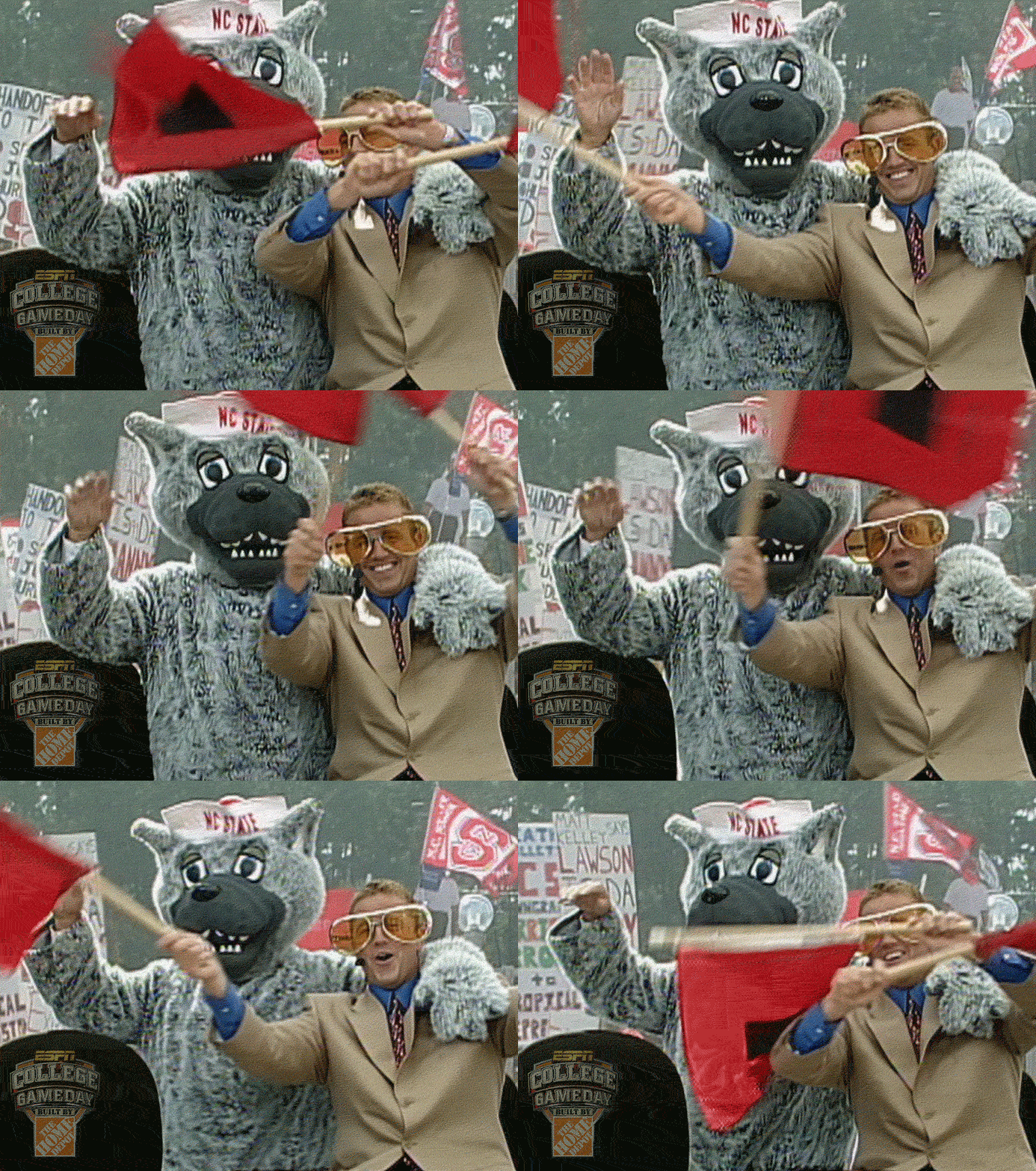
Lee Corso as Mr. Wuf 

Lee Corso almost didn’t make it through his second season as Florida State’s quarterback, much less 38 years of broadcasting on ESPN, thanks to a 1954 game at NC State’s Riddick Stadium.

“We’re going to drown, Buddy,” Corso told his college roommate as they lay at the bottom of a pile up at the Wolfpack’s one-time on-campus stadium. “We’re going to die right here on the football field.”

Buddy Reynolds, of course, became more famous as an actor when he changed his named to Burt and moved to Hollywood, pushed out of footballbecause of a game against the Wolfpack three years later.

On Oct.16, 1954, many people thought they were going to die, mainly because the most powerful hurricane to ever hit the North Carolina,Hazel, was still trailing its way across the East Coast. It made landfall the day before on the North Carolina-South Carolina border and caused some damage in Raleigh, including blowing the roof of the Riddick Stadium press box. In all, the Category 4 hurricane killed 95 people in the United States.

Florida State’s football team wasn’t sure their players would be healthy, either, having escaped the largest polio outbreak in state history, which was raging across the panhandle. It was a mild version of the rampant disease, but so pervasive it was later named “The Tallahassee Strain.”

None of that mattered to Lee and Buddy that night on the field that later became main campus’ biggest parking lot, as water streamed through the ear holes of their helmets. They were unable to get up because of the defensive tackles laying on top of them on the notoriously swampy field.

“We’re going to die,” Corso gurgled one last time.

They didn’t, of course. In fact, they went on win the game 13-7, as Corso rushed seven times for 22 yards. The decisive play was a controversial punt block in the fourth quarter that put a damper on Homecoming crowd of 9,000.

Corso had other opportunities to stand out against the Wolfpack, particularly during his 1956 return to Riddick Stadium. He was the star of the Seminoles’ 14-0 victory on Oct. 13, 1956. He scored the Seminoles’ first touchdown on a 35-yard run and set up the other with a 61-yard punt return.

“They have a fine player in that Corso,” said NC State coach Earle Edwards. “He was the difference. He had more to do with the outcome than any other individual.”

For the game, Corso had 10 carries for 108 yards, completed five of his run-option passes for 74 yards and had a big day as punt returner.

Corso did have another significant interaction with the Wolfpack at its new field, Carter Stadium. On Oct. 4, 1975, Corso was the head coach at Indiana, trying to get a scouting report on an undersized freshman running back in the Wolfpack backfield.

That running back, Ted Brown, had almost quit the team two weeks before, but was inserted into the starting lineup by Wolfpack coach Lou Holtz after his veteran tailbacks fumbled the ball away five times the week before in a regionally televised 37-15 loss at Michigan State. Brown was joined by fellow freshman Scott Wade, who gained 55 yards, and Ricky Adams, who gained 62.

Corso and his staff didn’t figure out a way to stop Brown, who rushed for 121 yards and two touchdowns. The High Point native finished his career as the Atlantic Coast Conference’s all-time rushing leader with 4,546 yards (plus 399 uncredited bowl yardage), a record he still owns almost a half century after his career ended.

“We just got beat,” Corso said after the game. “When you get beat, you take your bat and ball and go home, and you get ready for the next game.”

The next season in Bloomington, Indiana, Brown ran for another 141 yards on 23 carries with two more touchdowns against the Hoosiers.

On the positive side, no one drowned.


Thursday, August 28, 2025

The ECU-NC State rivalry began with the theft of Mr. Wolf


A returned Mr. Wolf leads three live dog mascots into Carter-Finley Stadium in 1970.

NOTE:
If you enjoy reading "One Brick Back" and would like to help offset research expenses for stories such as this one, please make a small donation to the cause and help keep posts like this free of ads.

© Tim Peeler, 2025

The first game in the NC State-East Carolina rivalry began with thievery. The most recent one ended in fisticuffs on the grounds of a military academy.

Fortunately, no weapons were involved.

There has always, however, been some amount of battlefield-level conflict between the two state schools that dominate the eastern part of North Carolina because of their passionate fanbases, their overlapping recruiting territories and their general disregard for each other’s positive attributes.

That conflict will return tonight at Carter-Finley Stadium when the schools renew the rivalry that began in 1970 and was played annually until 1987, when all hell broke loose.

Again.

Writing about that conflict has been a big part of my college football coverage through the years, when I worked at newspapers around the state and when I worked for the NC State athletics department. I even spent time on a university-led committee to find solutions for the rowdiness, along with an assistant housing director who later ended up being East Carolina's athletics director. 

After three years of covering the State-ECU rivalry in the press box for the student newspaper, Technician, I actually was on the opposite side of the stadium in the student section for 1987's earth-shaking game, thinking it would be nice to enjoy the game with friends in my last semester at school.

When the Pirates took and early and raucous lead in what turned out to be a 32-14 ECU win, I turned to my date and said: “Let’s get the hell out of here before this turns ugly.”

It turned ugly. (The game, not my date.)

What happened afterwards has been well-chronicled through the years. Mostly Pirate fans took the field and tried to uproot the goalposts. NC State athletics director Jim Valvano canceled all future games against East Carolina. The Peach Bowl decided to renew it on New Year’s Day 1992. The two teams have played multiple times, though not annually, since then.

And the Military Bowl paired the two teams together last December, re-inflaming the rivalry and some of the animosity that has flared up through the years with a postseason game.

To be fair, the difficulties began before the rivalry did, thanks to an automobile break-in on a Raleigh sidestreet. On the Wednesday before the first ever matchup between the Wolfpack and Pirates (Oct. 10, 1970), someone broke into senior Dick Scott’s car, parked on Furches Street in between Hillsborough and Clark Avenue.

The villains stole the only thing of value Scott had in the backseat: The Mr. Wolf mascot costume.

He kept it in there throughout the week so no one on campus would take it, but when he went to his off-campus parking spot the fuzzy gray felt body suit and floppy felt head were gone. He reported the value of the setup at $210 for the suit and $40 for the newly remodeled head (about $2,100 in today’s dollars).

So Mr. Wolf, long before his name had to be shortened to Mr. Wuf, was not on the field for the game. Scott sat with the cheerleaders, the lonelier than a freshman at a frat party. It didn’t much matter, though, as State easily won the game, 23-6.

Mr. Wolf seems happy to be back in action.
Scott and his cheerleading teammates were quite upset, because a new suit would have cost about $400 to replace before basketball season, when they would be expected to help head coach Norm Sloan and team defend their Atlantic Coast Conference championship.

“However, we are desperate to have the suit back in time for our remaining conference football games,” told Technician, NC State’s student paper.

Scott promised that if the hooligans who stole the wolf costume returned it in time for the Duke football game, he would let them borrow it back for Halloween.

At the time, it was too hard for students on campus to get too worked up about the loss of Mr. Wolf. They were too enraged that Vice President Spiro Agnew had just accepted an invitation to address a rally of Republicans at Reynolds Coliseum, dispelling rumors that Led Zepelin and Jefferson Airplane would play a free concert on the Brickyard to protest the Agnew appearance (as reported by UNC-Chapel Hill’s Daily Tar Heel), a telephone threat of two bombs planted in the air conditioning ducts in Harrelson Hall and the discovery of a cigarette baked into a hamburger bun at Harris Cafeteria.

Two of those proved to be hoaxes. (Hint: the cigarette was real and the only effective protest of the Agnew rally was campus security towing two Secret Service limos from the parking lots behind Reynolds.)

No one could firmly put the theft’s blame on Pirate skullduggery, and Mr. Wolf’s absence did little to hinder the 24-6 win for a Wolfpack team that had been winless in its previous eight contests going back to the end of the 1969 season (0-6-2).

While the suit’s theft was well-covered in local media, its return was never announced. However, there are pictures of the mascot in football games after East Carolina and at all home basketball games.

That, however, was the atmosphere in which the rivalry started.

My introduction to college football was on Sept. 10, 1983, the first weekend of my freshman year, which is the unofficial kickoff to the rivalry’s heated passion. It was a late-night game that bumped the Atlanta Braves off cable superstation WTBS, so that a national audience, if it cared to, could watch what unfolded that evening.

Fans of both schools were well-lubricated prior to the 8 p.m. kickoff and were rowdy throughout.

Or, as my late friend Bruce Winkworth put it in his column after the game, “It always hurts to lose to East Carolina because of their fans, for they may well be the most obnoxious and insufferable lot of bumpkins around. I walked the parking lots prior to the game and nothing I saw at any of their tailgate parties did anything to enhance my extremely low opinion of [Pirate] fans.”

State took a two-touchdown lead through the first three quarters, but turnovers and some big plays by the Pirates made the game close in the final minutes of head coach Tom Reed’s first game.

An estimated crowd of 57,700, then the largest number of spectators to see a sporting event in the state, stayed in their seats or stood at their standing-room-only ground until the final play.

East Carolina had taken a 22-16 lead thanks to a Wolfpack turnover, and the teams traded fumbles twice more in the final four minutes. State had a chance to retake the lead with 15 seconds remaining on the clock. On fourth-and-1 from the 10-yard line, new quarterback Tim Esposito ran the only option play of the game, pitching the ball to halfback Vince Evans.

He was knocked for a 7-yard loss that ended the game, ruining a good offensive performance that included 160 yards on 21 carries by junior tailback Joe McIntosh.

East Carolina flooded the field, a precursor to similar celebrations in 1985 when a restraining fence at the bottom of the grassy bank was uprooted and the total takeover of the field and goalposts in 1987. State fans did their part, as well, raining empty liquor bottles on to the field from the student section. Eyewitness accounts said dozens flew on to the field, with each miss eliciting groans from the crowd.

It made Winkworth rethink who the worst fans were.

“I was ashamed to be from the same university,” he wrote.

(The 1983 loss is so unpalatable that since 1999, the NC State football media guide has recorded that game as being played in Greenville, seemingly unwilling to accept that all the disruptions in that game and all that followed began in the state capital. Wikipedia and College Football Sports-Reference have recorded it the same way. State’s first visit to ECU’s Dowdy-Ficklen Stadium was Nov. 20, 1999.)

The five games in the 1980s turned what had been a mostly assured State victory into a competitive series, which has been great for football in the state, which is only diminished by the rabble behavior in the stands and on the field.

Here's hoping the 2025 game, the first in the rivalry ever played on a Thursday night, is free of such things.


Monday, March 24, 2025

A Lifetime of NC State Basketball Coaches

A panel discussion on the history of NC State basketball.

NOTE: If you enjoy reading "One Brick Back" and would like to help offset research expenses for stories such as this one, please make a small donation to the cause and help keep posts like this free of ads.

© Tim Peeler, 2025

On Tuesday, former McNeese State coach and Clemson graduate Will Wade is set to become the 10th NC State men’s basketball coach of my lifetime (if you count the three-day tenure of former DeMatha Catholic High School coach Morgan Wootten, which I do).

Press Maravich had just taken over from Everett Case a few weeks after I was born and went on to win an ACC championship in his inaugural year.

During that time, there have also been four Wolfpack women’s head coaches,  beginning the Peanut Doak in 1973-74.

I’ve had the good fortune to write about each of them in varying degrees. For posterity’s sake, I collected many of those stories from their various formats: newspaper, magazine, website and blogs. Click the link to check out my lived history of Wolfpack basketball.

Men’s Basketball Coaches

Press Maravich

A star basketball player at Aliquippa High School and at Davis & Elkins College, Press enlisted in the Navy during World War II, becoming a decorated pilot in the South Pacific. After the war, he played basketball professionally for some minor teams in the Midwest, but eventually chose to go into coaching, a profession far less dangerous than the coal mines and steel mills he grew up near.

He was the head coach at two high schools and six colleges — West Virginia Wesleyan, Davis & Elkins (his alma mater), Clemson, NC State, LSU and Appalachian State. After retiring from coaching, he became an assistant athletics director at Campbell. 

Norman Sloan

Monte Towe, the emotional point guard on Sloan's best squads at N.C. State, helped lead the coach to his greatest glory, as part of two ACC title teams and the 1974 national championship squad. He also was an assistant coach at Florida when Sloan was fired.

But for Towe, the head coach at the University of New Orleans, there is no tarnish on Sloan's legacy.

"He should be talked about as a great, great coach," Towe said. "Because that's what he was."

Morgan Wootten

Few may remember it, but Jim Valvano was not the first choice to replace Sloan, despite what the people on the search committee called the greatest in-person interview they had ever participated in. It had happened two weeks before in Washington.

The first choice of athletics director Willis Casey was Morgan Wootten, the famed coach of DeMatha Catholic High School in Hyattsville, Md. On the day Valvano was introduced, Casey so vehemently denied that Wootten had ever been extended an offer that it absolutely had to be true. Casey did say four college coaches had been interviewed for Sloan’s vacancy, and they were thought to be Valvano, Bill Foster of Clemson, Tom Young of Rutgers and Jack Hartman of Kansas State.

In other words: Who?

Jim Valvano

Just a few weeks before his 40th birthday, NC State coach Jim Valvano considered life as a middle-aged basketball coach. Sadly, ne never got to be a retired coach or television commentator.

“I guess I’m going to have to get serious about life,” he says, contemplating a number that before only described his jacket size. “I better figure out what I want to do in life.”

Considering he’s had a sampling of almost everything, Valvano shouldn’t have a hard time deciding. During his previous 39 years, and especially in his six years in Raleigh, Valvano’s been having a ball.

“I tend to enjoy almost everything I do,” he says.

And he tends to do everything he enjoys.


Les Robinson

Former star Chris Corchiani, who played his senior season under Robinson and maintained close contact with his former coach, agreed that Robinson had an important tenure at N.C. State, even if there were more losses than wins.

"I thought Les Robinson had a great impact on Wolfpack basketball," former point guard Chris Corchiani says. "He was a bridge from the troubled times when he came in to the success that the program is having now.

"He didn't have as much success as he would have liked, or as much success that the Wolfpack faithful would have liked him to have, but he put the train back on the track."

Herb Sendek

Many people thought Herb Sendek was a little lacking on the personality front. Not his friends and family.

“Funniest guy I know, other than some comedians,” says his wife, Melanie Sendek. "If he ever has to change fields, he would be great at comedy. He's spontaneous. He just thinks of things. He's really good at that."

Sidney Lowe

Morgan Wootten, who benefited from Lowe’s playground-sharpened skills for three years as the head coach at DeMatha Catholic High School in Washington, D.C., says he never had a player with Lowe’s intuition and court sense.

"He understood the game so thoroughly,” Wootten said. “He made everybody else better. He made everybody else believe in themselves. He wanted to be part of something greater than himself. He left his ego at the door. When Sidney had the ball in his hands, you knew everything was going to be all right.”


Mark Gottfried

The Wolfpack’s new mentor is relying on his experiences of the last two years of working for ESPN as a television analyst. Since he was last a head coach, he has seen a variety of new things from other programs, gotten new ideas from other coaches and recharged himself to face the challenge that lies ahead. He’s ready to run a program again, to teach the game to young players and to have the relationships he missed while he was out of coaching.

"I think, when I was coaching [before], I got going so fast ... I'm not sure my family I appreciated as much; I'm not sure I appreciated my job as much," Gottfried said in one of the many interviews he did after he settled into his job. "My team, my players: I think I've learned to appreciate those more. ... That's the thing when you're out of coaching, you miss it — just getting back to having that kind of relationship with everybody."

Kevin Keatts

This is a national championship program, so I consider this to be an unbelievable opportunity for me, something I don’t take for granted. I will work every day like it is my last day of work, that if I don’t do well, I have a chance to get fired. That’s the way I am going to build this program.

I am going to be the first person in the office and the last person to leave. I will be the first person to the court. I told those guys, no matter what you are going through throughout the day, it’s important that when you walk between those lines, that you are focused on NC State basketball. If we can get everybody to play together, to play for NC State, that will go a long way.

Will Wade

At his introductory press conference, Will Wade was brash and confident in his optimism.
 
“I want to be very clear,” Wade said. “This is not a rebuild. We're going to be in the top part of the [Atlantic Coast Conference] next year and we're going to the NCAA tournament.

“Make sure you have that on camera. This is going to be done quickly. We are here to win.”

Fifty years ago, when the NC State women’s basketball team played its inaugural varsity game, more than 11,000 curious spectators showed up at Reynolds Coliseum to see the first women’s team sponsored by the athletics department — and the only program to be fully integrated from its inception — debut on college basketball’s biggest stage.

That attendance might have been slightly boosted by the fact that the debut, under the guidance of interim head coach Robert Renfrow “Peanut” Doak, was the opening game for a doubleheader against Virginia with the Wolfpack’s top-ranked and defending national champion men’s team, featuring seniors David Thompson, Monte Towe and Tim Stoddard.

Regardless, it was a State sweep on Dec. 7, 1974, with the women winning 57-45 and the men winning 101-72.

Kay Yow

[Kay] Yow came along at just the right time: just after passage of Title IX of the 1972 Educational Acts that guaranteed women equal access to school-sponsored athletics at colleges and universities that received federal money. It opened the door for her to open the door for others, giving them the opportunity to play college athletics while getting an education.

Many times, however, Yow declared that she was “no women’s libber.” She wasn’t out to change the world or be a pioneer for equal rights. All she wanted to do was to be a successful coach, a righteous example and a good friend.

Funny, isn’t it, the unintended consequences of success?


Kellie Harper

She always knew that she would be a basketball player and a coach. Both her parents played basketball at Tennessee Tech. Her father, Ken, was a Tennessee high school coach and an assistant at White County High during Kellie’s junior and senior seasons there.

“I have always loved the game of basketball,” Harper said Thursday morning, shortly before she was named just the third women’s basketball coach in NC State’s history. “It’s been such a big part of my life. I could not imagine graduating college and not having that part of my life any more. I love teaching the game. I love it.”


Wes Moore

A native of Dallas, Texas, he’s a former office supply salesman who used that job to pay his way through college, working a year at a time to save money so he could go to school the following year, alternating between being a Dwight Schrute in boots and a Texas Pete Maravich.

Frank Weston Moore was a late bloomer whose educational journey took him from his hometown Dallas (Texas) Christian College to Johnson Bible College in Knoxville, Tennessee, thanks to strong childhood friendships, the Baptist-based Royal Ambassadors’ youth program and a boost from his first college coach, Gene Phillips, a former ABA player and NBA draft pick.

For the longest time, he was a scrawny little guy who hid his eating talents pretty well, even after marrying into a family with four generations of eastern North Carolina-style barbecue restaurant experience. He was basketball- and baseball-crazy, working off his calories in driveway pickup games and daylong sandlot games.


Kay Yow: A Symbol for the Fight

Kay Yow throws up her hands in the iconic Wolfpack gesture she helped popularize.

This Wolfpacker cover story was written in 2009 as an obituary overview of what Sandra Kay Yow symbolized as a coach, an inspiration and a representative of NC State.  If you enjoy reading "One Brick Back" and would like to help offset research expenses for stories such as this one, please make a small donation to the cause and help keep posts like this free of ads.

BY TIM PEELER

© Coman Publishing, 2008

Kay Yow never set out to be an inspiration any more than she set out to be a basketball coach.

All she wanted to do when she graduated from East Carolina University with a degree in English and a minor in Library Science was teach high school literature classes. Her first  and only  job offer came with a requirement that she had to coach the girls’ basketball team at Allen Jay High School in High Point.

Having never played the sport in college, and never coached on any level, Yow taught herself the rudiments of the game by reading whatever books she could find on offensive and defensive strategies. How appropriate for a would-be English teacher.

As it turned out, she was extremely good at inspiring her players, while in high school and as the coach at Elon College and at NC State, where she was the first person ever hired by the state of North Carolina to be a full-time coach and athletics administrator. She coached basketball, volleyball and softball.

Yow came along at just the right time: just after passage of Title IX of the 1972 Educational Acts that guaranteed women equal access to school-sponsored athletics at colleges and universities that received federal money. It opened the door for her to open the door for others, giving them the opportunity to play college athletics while getting an education.

Many times, however, Yow declared that she was “no women’s libber.” She wasn’t out to change the world or be a pioneer for equal rights. All she wanted to do was to be a successful coach, a righteous example and a good friend.

Funny, isn’t it, the unintended consequences of success?

Yow had a life-altering conversion in 1975, when she became a born-again Christian, thanks to the persistence of Laurie Moore, a diligent representative of the NC State Campus Crusade for Christ. Moore wanted to meet with Yow’s teams to talk to them about her belief in God and Jesus Christ. Yow put her off as long as she could.

“You are a good person, coach,” Moore told Yow. “But not every good person goes to Heaven.”

Yow attacked her Christianity with the same diligence as a full-court zone press, not just reading the Bible, but absorbing it, challenging it and living its teachings. During his eulogy at Yow’s funeral, Cary Alliance Church pastor Mitchell Gregory told of the many times that Yow called to ask a question about faith that she needed answered immediately. None of the questions were easy.

And it wasn’t easy being a faithful Christian while coaching nationally and internationally successful basketball teams. But Yow used her pulpit of the coaching box to spread her faith, by living a devout life that always focused on the positive. And, if she needed to, she was willing to smuggle Bibles into the Soviet Union to give away to secret Christians while on her wait to beat the Russians on their home turf.

So it was in 1987, when she was first diagnosed with breast cancer. It couldn’t have come at a worse time, of course. Yow was just a year away from leading Team USA into the 1988 Olympics in Seoul, South Korea. 

She had the radical mastectomy, the chemotherapy and the radiation treatments that sent the cancer into remission for more than 17 years and got on with her life. She continued to coach, continued to teach and continued to live a faithful life.

On occasion, she would help raise money for breast cancer awareness and prevention. She was the chair of the Raleigh’s inaugural Race for the Cure, a fundraiser for the Susan G. Komen Association. She wore the label of “breast cancer survivor” with pride.

Quietly, she would send notes and make phone calls to public figures and private citizens who she learned had been diagnosed with the disease, knowing that a little positive assurance would go a long way in that person’s treatment and recovery.

It wasn’t really until the disease returned  a rare occurrence, according to her long-time oncologist Mark Graham  that Yow b
ecame more than a participant in the fight against cancer. Shortly after it was rediscovered in 2004, Yow became a symbol for the fight.

Being in the spotlight was not necessarily easy for Yow, though she had plenty of practice as a basketball coach. It was, however, something she felt was necessary.

“I have always tried to be pretty open about my health,” Yow said in a 2006 interview. “For one thing, it helps other people. When I go in for my radiation treatments, I see so many others who are going through the same thing.

“I think I can be an encouragement to people, by just going on about my business, doing my thing. Life isn’t stopping because I have been diagnosed with a disease. A person might have a disease, and you could die from something else while you are worrying about this. You do what you have to do.”

Beating cancer – which she did for five years, until it began to take over her body late last year – became just another opponent to beat. She found the right strategy for her, which included being a high-profile spokesperson for awareness and prevention.

“If I kept this to myself, then it would be making this just about me,” Yow said in the same interview. “That’s not who I am. I have always been a team player. There is a big team of people out there battling cancer. You have to choose an attitude to fight and persevere.”

Yow chose to fight, and she commandeered the color pink to do it. Pink ribbons had long been the symbol for breast cancer awareness, but Yow turned them upside down – turning it into a pink Y.

In December, 2007, the Women’s Basketball Coaches Association worked with the V Foundation for Cancer Research to begin the Kay Yow/WBCA Cancer Fund. It is now the WBCA’s primary charity, the recipient of much of the money that has been raised in the organization’s “Think Pink” and “Pink Zone” initiatives.

In its first 13 months, the fund collected a little more than $700,000. Only a fraction of that money – about 20 percent – came from the nearly $1 million raised by the 1,250 “Think Pink” events held last year.

This year, more than 1,500 Pink Zone Events – including NC State’s Hoops4Hope that raised more than $91,000 – are expected to raise much more money for the Yow/WBCA Cancer Fund.

“The thing I'll always think about with Kay is how she made pink,” said Duke coach Joanne P. McCallie after Yow’s death. “She made pink something special. For the longest time, pink was something soft and feminine and suddenly it became this courageous fight that everyone's been united in, and that was one of her many legacies.

“She made pink more beautiful than pink could ever be.”

Being the spokesperson for such an organization is an exhausting proposition for a healthy person. It was sometimes overwhelming for someone trying to function with Stage IV cancer, as Yow did for the last three years.

“The thing about Kay is that her strength is divinely inspired,” said ACC senior associate commissioner for women’s basketball Nora Lynn Finch said. “Her source of strength is God-given. Even as she has had to deal with increasingly difficult health issues, her spirit continues to stay strong.”

That spirit is what people are most likely to remember about Yow, whose nine ACC regular-season and tournament championships and multiple gold medals have slowly taken a backseat in recent years to her fight against cancer.

In the same way that Jim Valvano, her long-time friend and former colleague, is now remembered more for his speech at the ESPYs  and the more passionate version he gave at Reynolds Coliseum  just weeks before his death in 1993, Yow will be remembered for her spirit, strength and courage.

And, while the NC State and women’s basketball communities mourn Yow’s loss, she leaves something more than just memories. The cancer fund established on her behalf leaves a legacy.

Sadly, that’s a legacy that is shared with some other important figures in the history of NC State basketball:

Fellow basketball Hall of Fame inductee Everett Case, who introduced big-time college basketball to the South, also died of cancer, in 1966, a little over a year after he helped the members of his final team cut down the nets at the ’65 ACC Championship.

Ronnie Shavlik, one of the most important recruits and accomplished players in the history of the ACC, died of cancer just months after he watched the Wolfpack win the 1983 NCAA Championship.

And, finally, Valvano, who died after a similarly public battle against cancer.

Perhaps they all battled for a purpose.

A couple of weeks ago, former NC State assistant and Duke head coach Vic Bubas was in town to talk to the Raleigh Sports Club. He knew Case, Shavlik, Valvano and Yow well.

“Each of them had a special message, a special courage, a special presence that maybe can serve generations in the future,” Bubas said. “They each showed us how to handle a horrible situation. It’s almost like God chose certain people, exceptionally strong people, to lead the fight.

“I am extremely grateful for what each of them left and I hope their work continues for more generations.”


Sidney Lowe: A Virtuoso Point Guard


Sidney Lowe in the red blazer he made famous.

NOTE: This story was a chapter in the book "When March Went Mad," a 25th anniversary celebration of NC State's 1983 NCAA championship. Lowe had just returned to campus as head coach, in the footsteps of Jim Valvano. If you enjoy reading "One Brick Back" and would like to help offset research expenses for stories such as this one, please make a small donation to the cause and help keep posts like this free of ads.

© Tim Peeler, 2008

Sidney Lowe always wanted to be a virtuoso. His mother, Carrie, thought the youngest of her nine children might be talented enough to elevate his fortunes from the family’s humble inner-city background to perform on the grandest of stages. She gave him a violin when he was little more than a toddler, and he loved playing the instrument.

At the age of 7, an elementary school teacher and youth league coach named Fletcher Tinsley took the bow out of Lowe’s hands and replaced it with a basketball. He’s been a court maestro ever since.

Lowe found his grand stage as a point guard and as a coach. To be honest, those two roles are the same. Morgan Wootten, who benefited from Lowe’s playground-sharpened skills for three years as the head coach at DeMatha Catholic High School in Washington, D.C., says he never had a player with Lowe’s intuition and court sense.

"He understood the game so thoroughly,” Wootten said. “He made everybody else better. He made everybody else believe in themselves. He wanted to be part of something greater than himself. He left his ego at the door. When Sidney had the ball in his hands, you knew everything was going to be all right.”

That’s how Jim Valvano felt when he became NC State’s head coach in 1980, inheriting the DeMatha-bred backcourt of Lowe and Dereck Whittenburg. The day he got the job, Valvano called his younger brother Bob. The first insight he had about his new team was not the depth of his talent, the grand scale of the program or the passion of the people who followed the Wolfpack. It was a simple observation: “This is going to be fun because I’ve got the best point guard I’ve ever had,” Valvano said. For next three years, Valvano called the plucky player “Coach Lowe.” When the ball was in play, Valvano gave Lowe full reign of the team. The guard had permission to call any play he thought would work, to overrule the coach on any possession. There was only one thing Lowe wasn’t allowed to do: come out of the game. Whenever he asked to take a breather, Valvano either ignored him or repeated the line he first told Lowe as a sophomore: “You are not coming out of the game until your eligibility is up.”

Lowe never complained. He wanted to be in the game, not to score, but to conduct the symphony that played out every night on the basketball court. His unselfish attitude made him a coach’s delight. “I’m not going to score if it’ll take points away from somebody else,” he once told Tom Harris of Raleigh’s News & Observer. “My job is to keep everybody  the players, the coaches  happy. If I score, it helps one person  me. If I pass off to someone and he scores, I’m helping three times as many or more… because I get an assist, the player gets the points and that helps the team. If I pass to somebody and he goes in for a dunk, that helps even more because it fires up the crowd and makes the team play harder.”

There is a reason that Valvano and Wootten  as well as other coaches like Bill Musselman, Mike Fratello and Flip Saunders  wanted Lowe by their sides: He had a winning intuition. At DeMatha, he had to wait his turn in one of the nation’s most accomplished high school basketball programs  he wasn’t a regular starter until his senior season. Still, under Lowe’s baton, DeMatha won back-to-back city and state championships in 1978 and ’79, the same years he wore an upperclassman’s red jacket instead of the blue blazers that identified the school’s underclassmen. He made an immediate impact at NC State, replacing three-year starter Clyde Austin as the Wolfpack’s starting point guard and finishing second in the ACC Rookie of the Year race to Virginia’s Ralph Sampson. Lowe went on his only international tour in 1981, leading Team USA to a gold medal in the World University Games in Bucharest, Romania, with a hero’s symphony in two parts. First, he made a 70-foot jumper from the top of his own key at the end of the first half of what turned out to be a double-overtime classic against the Soviet Union. Days later, in the final moments of the gold-medal game, the fearless six-foot guard drove past seven-foot, five-inch center Vladimir Tkachenko for a game-sealing three-point play.

At NC State, Lowe quickly elevated himself to be among the school’s great conductors, Lou Pucillo and Monte Towe. The Wolfpack appeared in three NCAA Tournaments in his four years and won both the 1983 ACC Tournament and NCAA Tournament championships. His ACC-record of 762 career assists was eventually surpassed, but in the 25 years since he played no guard has come close to his career 2.94 assist-to-turnover ratio. He twice led the ACC in assists, was twice named all-conference and won the Everett Case Award as the 1983 ACC Tournament’s most outstanding player. As a professional player, he won three Continental Basketball Association championships as Musselman’s floor leader.

Lowe, as a stocky six-foot guard, never found the same kind of success in the NBA, bouncing through five different organizations as a player. But he did work his way back from the brink of retirement to become a productive role player for the Minnesota Timberwolves, a comeback that gave Lowe a path into coaching. The Chicago Bulls took Lowe in the second round of the 1983 NBA Draft as the 25th overall selection, then immediately traded him to the Indiana Pacers. He spent one season there, then bounced from Atlanta to Detroit in the NBA, before finding a permanent home with the CBA’s Tampa Bay Thrillers in 1984-85. After winning back-to-back CBA championships with the Thrillers, he gave up his dream of returning to the NBA in the summer of 1986. He took the only job he ever had out of basketball, managing The Magic Moment, an upscale Sarasota, Fla., restaurant owned by his Thrillers boss, Jeff Rosenberg. Lowe enjoyed running the 275-seat restaurant, handling inventory, checking in food supplies, closing the place down at night. He went an entire year without touching a basketball, spending his free time playing golf and tennis. Lowe was a conductor, though, not a chef. He needed to return to basketball. Besides, what restaurant lets the maitre d’ wear a red sports coat?

In the summer of 1987, Lowe bumped into former Wolfpack teammate Thurl Bailey at a basketball camp in Utah. After watching Lowe for a few games, Bailey convinced his friend to give basketball another try. Lowe rejoined Musselman with the Albany, New York, Patroons, which set a modern-day record for winning percentage with a 48-6 mark in the regular-season and won another CBA title. By the next year, however, Lowe returned to the Thrillers’ franchise, which had moved to Rapid City, South Dakota. It was a crossroads in Lowe’s career: far from his family, which had long been settled in Raleigh while Lowe was off chasing his hoop dreams; far from the bright lights of the NBA or even the lowered lights of the restaurant lounge; far from everywhere. Would Leonard Bernstein go to the Black Hills to lead a high school band in Sousa marches?

Just as Lowe preparing for another trip to the CBA playoffs, he got a call from the Charlotte Hornets. The second-year NBA franchise signed him to a 10-day contract, offering him a chance to return to the highest level of professional basketball and the chance to return to his family in North Carolina. (Lowe married his college sweetheart, Melonie Moultry of Winston-Salem, soon after she graduated from NC State in the summer of 1984; she has maintained his family’s permanent residence in Raleigh since 1985.) The next season, he signed a $500,000 contract to play for the expansion Minnesota Timberwolves and Musselman, his long-time professional mentor. It was the beginning of a long-standing relationship with the franchise that included a post-playing career job as a television analyst and as an assistant coach for both Musselman and Jimmy Rodgers.

On Jan. 11, 1993, Rodgers was fired and Lowe was elevated to lead the struggling Timberwolves. At 34, he was easily the youngest head coach in the National Basketball Association. Valvano, for one, could barely contain his excitement. “Sidney Lowe was the brightest player I ever coached in 23 years,” said Valvano, who had just begun his public battle with cancer. “He was the epitome of the cliché ‘coach on the floor.’ I have already updated my resume and applied for an assistant’s position with him.”

It was an unusual and difficult year for Lowe one of the players on the Timberwolves roster was Bailey, the former NC State teammate who had convinced Lowe to give the NBA another shot. “Beyond weird,” Bailey said, in describing what it was like playing for Lowe. The franchise had little chance to succeed in those pre-Kevin Garnett days in Minneapolis, and the losing took its toll on a coach who had won national championships in high school and college and three professional titles as a player. He thought he could make his young players play as hard as he would have, that he could force them to always make the right decisions, that they would care about every game as much as he did. It was a time of great personal reflection for the young coach. “I missed my exit several times, going home late at night,” Lowe said. “I drove past it by 20 miles sometimes.”

During one road trip to Phoenix, legendary Suns coach Cotton Fitzsimmons asked Lowe to drop by for a little free advice. “He took me in a room and said listen, the only thing you can do is make sure your kids play hard and that they are organized,” Lowe said. “The reality, right now, is that you are not going to win many games. I didn’t want to accept that. But what he was telling me was that I had a very young team, and I needed to make sure we did all the small things.” Lowe learned that he didn’t have to conduct with a mallet.

Lowe, like his two predecessors in Minnesota, didn’t last long as the head coach of the Timberwolves, who fired Lowe after just a year and a half. He spent the next five years as an assistant coach with Mike Fratello and the Cleveland Cavaliers, positioning himself for another opportunity to be an NBA head coach. That chance came on June 1, 2000, when he was hired as the head coach of the Vancouver Grizzlies. He shepherded the team’s relocation to Memphis, but resigned from the job after the Grizzlies lost their first eight games in 2002, ending his NBA head coaching career with a 79-228 record. Lowe once again returned to Minnesota, this time working as an assistant for Timberwolves head coach Flip Saunders. He stayed there until 2005 when Saunders and his entire staff moved to the Detroit Pistons.

It was near the end of Lowe’s first season with the Pistons  which had amassed the best regular-season record in the NBA  that Lowe began working with NC State athletics director Lee Fowler to come up with candidates for NC State’s head coaching positions. At first, Lowe was simply giving Fowler his thoughts about high-profile candidates who Fowler was courting. “We need to get someone who really … understands the competition, that understands the ACC, that understands that you can walk out of your house and you next-door neighbor may be in blue,’” Lowe said. Eventually, it dawned on Lowe exactly who he was talking about  himself. “I think I’m going to go for this job, because everything I told Lee, that’s me,” Lowe told his wife. He was eager to bring his coaching knowledge and his NBA experience back to the school that he loved, even though he had never coached or recruited on the collegiate level. Fowler jumped at the chance to reunite NC State with one of its most decorated alums, and was willing to wait for the Pistons to be eliminated from the NBA playoffs.

There was a problem: Through all of Lowe’s travels chasing his NBA dream, he never completed his business management degree, despite his many promises to his mother, Carrie Lowe, that he would one day become the first member of his family to graduate from college. He was well short of that degree when he left school in 1983. He spent the next two decades chasing other dreams. “When I went to the NBA, I had a family,” Lowe said “At the time, my priorities were God first, my family second. I had to support them. That meant working camps in the summer and concentrating on taking care of them as opposed to worrying about myself.”

One of the things Lowe always wanted to do was buy his parents a new house and move them out of the inner-city Washington apartment where his mother was a maid. During his final season at NC State, Lowe told a group of junior high students, “I have a dream … to someday put my Mama in a big house and let her have a maid to bring her cookies.” When he signed his biggest contract with the Timberwolves, Lowe bought a house for his parents and moved them to Raleigh, along with three of his sisters. He considered it just a small part of his repayment for the sacrifices his mother made to support nine children and a disabled husband. One of those sacrifices was the overtime she had to work for three years to afford his private-school education at DeMatha.

Carrie Lowe was looking for a different kind of repayment. “I always asked him, ‘What’s going on with your degree? OK, get to it,’” she said. “I constantly reminded him that he needed that degree.” He also got an earful from his frequent golfing buddy, Dwayne Green, a former NC State football player, who waved his degree in front of his friend’s face every time Lowe won on the golf course.

Over two decades, Lowe gradually reduced the number of hours he needed to get the degree, and by the time Fowler came calling, he was only two classes short. He made a commitment to finish them at St. Paul’s College in Virginia, and Fowler made getting the degree a requirement of his employment.

On May 6, 2006, in an emotional press conference on NC State’s campus, Lowe was introduced as the 18th head coach in Wolfpack basketball history, a position Valvano once predicted he would have. In his first meeting with his new team, Lowe made a simple promise to the players: “I told them I don’t have a lot of rules, just a few. To play hard, to play smart to play together and, the most important thing of all, the biggest rule I have, is to have fun.” After the perfunctory questions from the media, Lowe walked from floor of the Dail Basketball Practice Center, the site of his introduction, through the woods and down the hill to the Paul Derr Track, where nearly a thousand Wolfpack fans were eagerly waiting to welcome him home.

Wearing red and white, they shouted his name and cheered his arrival. For the next forty-five minutes, Lowe talked and mingled. He introduced his family to faces he hadn’t seen in many years. Before he left, Lowe raised both arms to flash the traditional wolf sign with his fingers and thumbs, and the crowd cheered wildly. The maestro was on his home stage once again.

Weeks later, with tears in his eyes, Lowe knocked on the door of the home he bought his parents and handed his mother the diploma he had just gotten in the mail. “Through all of the athletics accomplishments and all the things I have done in coaching, she is more proud of me getting that degree than anything else I have done,” Lowe said. “To be able to show her that diploma, basically at the same time I was named the head coach at NC State, is a dream I never thought would come true in a million years. I think there was some kind of divine help here that made everything possible for me. It worked out perfectly.”

There were times that the Wolfpack struggled during Lowe’s first season. He had a short bench, a thin roster, a long learning curve, a rash of untimely injuries: many of the hurdles that new coaches face during a transition season. Lowe was not deterred. “I am the head coach at NC State University,” he said. “How can I not be excited?” He showed it by ordering a tailor-made red jacket to wear in big games, just like Valvano used to do. He unveiled the good-luck charm on the January afternoon when the Wolfpack beat second-ranked North Carolina in Raleigh. By the end of the season, Lowe had a dry-cleaner on call to keep his jacket clean during a four-day charge to the ACC Tournament title game in Tampa, Fla. The Wolfpack came up short against the heavily favored Tar Heels in the final game, but Lowe’s first-year message was clear to anyone who might have doubted that he could put the Wolfpack in position to win, as he did during his playing days.

He’s ready to conduct the encore.


--30--