Friday, September 7, 2018

NC State's First NFL Quarterback


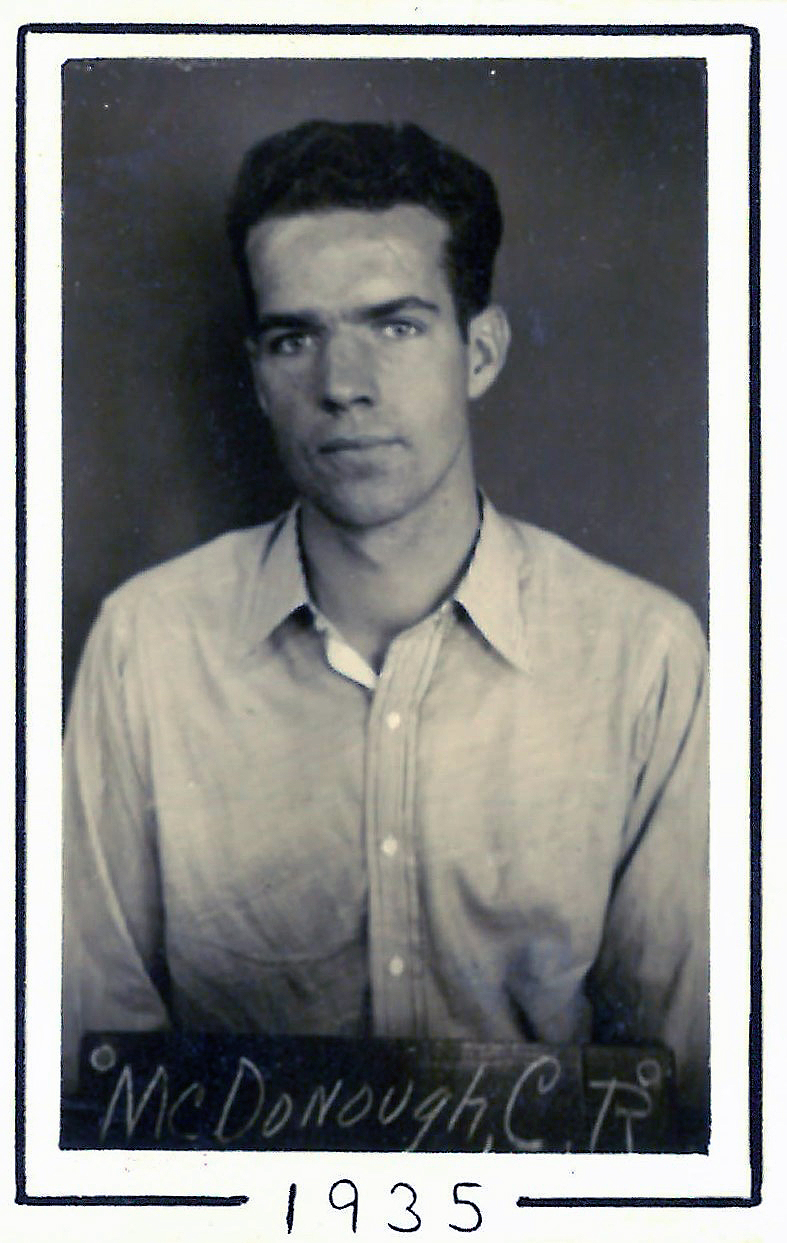
Sitting to the right of Little Artie Rooney on the second row is Coleman R. "Coley" McDonough (identified in this Agromeck photo as "McDenna"), NC State's first NFL quarterback.


© Tim Peeler, 2018

NOTE: If you enjoy reading "One Brick Back" and would like to help offset research expenses for stories such as this, please make a small donation to the cause and help keep these posts free of ads.

About this time last year, as four former NC State quarterbacks were ready to take on starting roles for four different NFL teams, the Wolfpack rightfully adopted the hashtag #QBU.

Not only were Philip Rivers, Russell Wilson, Mike Glennon and Jacoby Brissett ready to roll, they were part of a successful club of Wolfpack professional quarterbacks that also included Roman Gabriel and Erik Kramer, both of whom spent double-figure seasons as starters under center in the NFL.

So imagine my surprise in the off-season when I learned that Gabriel, the two-time All-American and two-time ACC Player of the Year who was the No. 2 selection in the 1962 NFL draft, was not the first NC State alum to become a successful starting quarterback at the game’s highest level.

That distinction belongs to Coleman “Coley” McDonough of North Braddock, Pennsylvania, a name that has faded to practically all Wolfpack fans and is barely a memory to a handful of his dwindling family in suburban Pittsburgh.

His story, however, is compelling, from its auspicious beginning to its tragic end, in the circuitous route he took from Pittsburgh to Raleigh to Dayton to the Battle of the Bulge back to the shadow of his hometown, where he found his greatest glory and his heroic demise.

It’s a story I knew nothing about until just a few weeks ago, when his name showed up on a little-used list of NFL players with ties to NC State. It’s there plain as day, listing McDonough as a halfback/quarterback during the NFL's difficult World War II era, but it rang no bells in my cranial database of former Wolfpack players capable of playing in nearly two dozen games over the course of four NFL seasons.

Preliminary searches didn’t reveal that name on the school’s letterman list or in the school yearbook. Buried, however, deep in the school newspaper archives were details of the 1935 freshman team, one of the best in school history, thanks to a handful of players who went on to have NFL success.

The most recognizable name on freshman coach Bob Warren’s team was Little Artie Rooney, the first cousin of NFL pioneer Big Art Rooney, owner of the Pittsburgh Pirates/Steelers. In fact, Rooney and McDonough both made the journey from the Quaker State to Raleigh to play for the Pack, along with another future NFL champion Mac Cara.

McDonough was the Wolflets' starting quarterback throughout the season, though Rooney and Kenneth Sands did most of the play-making in the T-formation offense. Freshman coach Bob Warren’s team was practically unstoppable, posting a 4-1 record and outscoring its opponents 146-21.

McDonough scored 18 of those points, making a perfect 12 of 12 PATs and scoring the lone touchdown of his freshman season in a 65-0 rout of Davidson. He also recorded a 75-yard punt.

With older players like Eddie Berlinski and Everett "Cowboy" Robinson returning, varsity head coach Heartley “Hunk” Anderson looked like he might be on the verge of building a Southern Conference power.
It wasn’t to be, however. Following the 1935 football season, NC State, North Carolina and several other Southern schools adopted UNC System President Frank Porter Graham’s short-lived plan to severely diminish competitive football on college campuses, eliminating scholarships, discontinuing off-campus recruiting and strictly forbidding postseason bowl games, among other measures. Because of alumni and sportswriter outrage, the experiment lasted less than one academic year.

Not surprisingly, however, McDonough and several other promising players left the Wolfpack program. McDonough transferred to Dayton, where he played another freshman season in 1936, scoring all 13 of his team’s points in the end-of-season "Red and White" game.

As one of two star halfbacks, McDonough helped the Flyers' varsity post back-to-back 7-2 marks in 1937 and ’38 in the Buckeye Athletics Association, but he was dismissed from the team in 1939 for breaking the iron-clad team rule of getting married--to the sister of his fellow halfback.

The beefy 6-foot-2, 210-pound signal caller instead played for two NFL teams in 1939, the Chicago Cardinals and Big Art Rooney’s Pittsburgh Pirates. McDonough played 10 games over the next two seasons for Rooney’s team, renamed the Steelers, but did not play in either 1942 or ’43 after being drafted into military service.

He returned to the NFL in 1944 as a member of one of the most unusual blended teams in NFL history. The year before, because of war-time talent depletion, the Steelers and the Philadelphia Eagles merged to form the “Steagles,” a partnership that lasted less than a year.

The next season, for the same reason, the Chicago Cardinals and Steelers merged into a team called Card-Pitt, splitting their home games between Wrigley Field and Forbes Field. Six days before the second game of the season, McDonough was recalled into the Army and shipped overseas just in time to prepare for the Battle of the Bulge, which he survived as a tank destroyer commander for the 740th tank battalion.

Without McDonough, Card-Pitt completed just 31 percent of its passes, threw 41 interceptions and only eight touchdowns. Winless and hapless in 10 games, even Rooney called his squad “the worst team in football history.”

McDonough’s football days were over by the time he returned from Europe, a victorious but jobless GI looking for something to do in the booming post-war economy. His NFL career wasn’t particularly memorable. None of the teams he played on ever won more than two games in a season. In his career, he completed just 38 percent of his passes, throwing five touchdowns and 22 interceptions.

After he left the Army, he worked for the Pennsylvania bridges department, then joined the Pittsburgh Police Department in 1950.

On the night of July 5, 1965, Patrolman McDonough and his partner answered a routine domestic disturbance call in the rundown Pittsburgh neighborhood of Hazelwood. As he entered the home, McDonough discovered the dead body of the homeowner, whose underage daughter had been arguing with her boyfriend, 25-year-old Leroy Scott.

Scott shot McDonough six times with a .22 caliber repeating rifle, while two other officers were injured by gunfire. McDonough, 52, died at the scene.

The girl’s boyfriend fled into a wooded area adjacent to the Monongahela River, where he kept 200 policemen at bay overnight. After a five-hour standoff, two officers found Scott in a tree; they shot him as he raised his rifle in their direction. He died en route to the hospital.

McDonough’s son, Coleman McDonough Jr., also became a law enforcement officer in his home state, serving 24 years as a Pennsylvania state trooper and retiring as deputy commissioner of the Pennsylvania State Police. He served seven years as the chief of police in the town of Mount Lebanon and, in 2016, was named the superintendent of police in Alleghany County, the same district where his father was killed in the line of duty.

“My father was a hero to me my whole life,” Supt. McDonough says. “He died when I was young, only 10, but I do have many memories of the time we spent together, playing baseball and doing other things. He often served as the clubhouse security guard at Forbes Field for Pittsburgh Pirates games. He got to know the clubhouse attendant really well, and he used to bring me a signed baseball home just about every week.

“He got me several Roberto Clemente autographed balls, but to me they were just something to play with in the street. We wore those names off pretty quickly. Probably the greatest day of his life was being there when Bill Mazeroski hit 'The Shot Heard 'Round the World” in Game Seven of the 1960 World Series."

McDonough has a few pictures of his father as an athlete, a collection that has had a 1935 mugshot and an NC State freshman team picture added to it in the last week or so.

“We had a large family, but most of them are gone now,” McDonough says. “We have some memories of those teams he played with, but few other people do. I’m a big football fan, so I remember Gabriel when he was with the Philadelphia Eagles and Kramer when he was with Chicago. I know all about Philip Rivers and Russell Wilson and the other quarterbacks from NC State in the NFL.

“It’s an honor to have my dad remembered as part of that group.”

I feel pretty sure those guys would say the same about NC State’s first NFL quarterback, who was more than just a passer and punter.

He was a Pennsylvania hero.

Wednesday, August 29, 2018

Never Buy Wolves From a Guy Named Rattlesnake Joe


NOTE: If you enjoy reading "One Brick Back" and would like to help offset research expenses for stories such as this one, please make a small donation to the cause and help keep posts like this free of ads.

© Tim Peeler, 2018


Anticipation couldn’t have been higher as the end of NC State’s 1935 football season drew nearer.

It had been a good season, with the Wolfpack clutching to a 6-2 record just ahead of the home finale against Big Five and Southern Conference rival Duke. The only losses on the season were home games against Georgia and UNC, but they were offset by big wins over Davidson, South Carolina, Wake Forest, Virginia Tech, Manhattan and Richmond.

Heartley “Hunk” Anderson, Knute Rockne’s replacement a few years earlier as head coach at Notre Dame, was in his second season with the Wolfpack. He had three players who eventually ended up making All-America teams, in senior center Steve Sabol and tackles Vince Farrar and Mac Cara.

Two sincere NC State undergrads, Dick MacKenzie and Jim Coleman Jr., had an idea about three weeks before the game against the Blue Devils to buy live wolves to roam the sidelines of Riddick Stadium, a show of might and force that would surely strike fear in the heavily favored Blue Devils.

The pair spent day and night collecting pennies, nickels and dimes from their classmates—mind you, this was at the height of the Great Depression—to collect the $45 needed to buy a trio of Minnesota timber wolves from a South Carolina snake and alligator collector who lived, unbeknownst to the students, in a ratty tent on the banks of the Santee River.

A week before the big game, the students were still far short of their goal, some 80 years before GoFundMe became a thing. So a few Raleigh merchants with NC State loyalties—including Mayor George Iseley, Commissioner of Public Safety T.K. Fountain and Commissioner of Public Works S.J. Ferguson—pitched in the final few dollars to be wired to H. Ellison Mitchell, owner of the Palmetto Snake and Wild Animal Farm.

Or, as he was known to locals, “Rattlesnake Joe.”

On Thursday before the Homecoming contest, the two students and all their contributing classmates were worried that the wolves had not yet arrived. They called the stationmaster to see if there had been any canines loaded on a train headed to Raleigh in the previous few days.

There had not.

So Mackenzie and John Bing, a fellow student with his own car and a few cans of gas, headed to the South Carolina Lowcountry, intending to bring the three wolves to Raleigh in the back seat of Bing’s car. They drove all night long, some 200 miles on dark and unpaved roads, intent on completing their purchase.

When MacKenzie and Bing pulled up at the farm in the middle of the day, Rattlesnake Joe couldn’t have been more surprised. As it turns out, Joe only dealt in reptiles, not mammals. Not only did he not have any timber wolves in the chicken wire cages on his property, he had never seen one in his life.

The students were angry, but helpless. They managed to get $30 back from Mitchell, but had to file a mail fraud lawsuit in federal court in an attempt to get the rest of the money back. (There’s no record of the outcome of that lawsuit in subsequent newspaper accounts.) The two students, after fruitlessly checking around other Lowcountry farms, returned to Raleigh with an empty backseat, just in time for kickoff.

The lack of live mascots seemed to be a downer for Anderson’s team, whose season had started with such promise.

It not only lost to Duke 6-0 in the close Homecoming contest, giving Duke its second consecutive state and Southern Conference title, it also traveled to Washington on Thanksgiving Day to face Catholic University, The game was played at Griffith Stadium, home of baseball’s Washington Senators and Homestead Grays and the first home of the Washington Redskins, following the franchise’s move from Boston.

Three hours before the game, a massive rainstorm flooded the nation’s capital, and three plays into the game no one could tell what player played for which team. The Pack lost 8-0 to the Cardinals, which had already been invited to face Southeastern Conference champion Ole Miss in Miami’s second-annual postseason game called the Orange Bowl.

The Wolfpack stayed home cold and alone, without even a three-dog pallet to cuddle up with.

Saturday, March 31, 2018

Even Valvano Couldn't Overshadow Danny and the Miracles


Jim Valvano: The Entertainer.


NOTE: If you enjoy reading "One Brick Back" and would like to help offset research expenses for stories such as this one, please make a small donation to the cause and help keep posts like this free of ads.

© Tim Peeler, 2018

Of course Jim Valvano stole the spotlight.

Here we were in Kansas City for the 50th anniversary of the NCAA Championship, the tournament the NC State coach and his Wolfpack won five years earlier in Albuquerque, New Mexico.

ACC- and East region-champion Duke was there, with junior Danny Ferry and a team that could win the national title it missed two years earlier. Pac-10- and West region-champion Arizona was there for the first of the program’s four Final Four and Lute Olsen was certain his team had a chance. Big Eight runner-up Kansas was there, with senior Danny Manny having just beaten cross-state rival Kansas State to qualify for its eighth trip to the national semifinals since 1957. And overwhelming favorite Oklahoma was there, with a high-scoring offense that averaged 96.8 points per game. (How good was Oklahoma? It allowed 99 points in a game that season--and won by 52.)

Valvano showed up without his team, which finished second in the ACC that season and lost to Duke in one of the few good games at that year’s ACC tournament in Greensboro. The third-seeded Wolfpack had lost in a huge upset to 14th-seeded Murray State in the first round of the NCAA’s Midwest region in Lincoln, Nebraska.

That was fortuitous for me, barely three months after graduating from NC State with a degree in English and just two-and-a-half months into my first professional newspaper gig with The Salisbury Post. I switched over to cover Duke at the East Regional in the Meadowlands, where they barely survived against 11th-seeded Rhode Island, 73-72, then blasted top-seeded Temple, 63-53.

But this was a place where I really didn’t belong. I was too green, too immature, too unprepared. I was dabbling in extended metaphor game stories.

Still, I took my place that Thursday afternoon in the media scrum in the lobby of the Hyatt Regency Hotel—the famous one where the walkway collapsed in 1981, killing 114 people and injuring 216 more—waiting for a coach/athletics director in a tailored suit to show up and talk to us.

Valvano, it seemed, was a candidate for the UCLA job, one of his many dalliances with other teams through the years. This one, though, was serious. The Bruins, according to several media reports and the words uttered right out of Dick Vitale’s mouth, were offering a five-year contract for $2.5 million guaranteed, remarkable money for a coach at the time.

Valvano, with a New York heritage and a Hollywood personality, seemed perfect for the job. After all, he had been connected with John Wooden since his time as a player at Rutgers, and the Wizard of Westwood had sent Valvano a hand-written following the ’83 championship. Los Angeles might have been the only place in the world with enough cameras and microphones for Valvano’s taste.

That afternoon, he was playing this dalliance for all he was worth.

Which, apparently, was a lot.

Valvano walked in with Georgia Tech coach Bobby Cremins on their way into the “Golden Salute to the Final Four” gala—surely, Valvano thought the red carpet was just for him—with all the other Division I head and assistant coaches and a slew of folks who paid big money to attend. Cremins giggled out the media’s view as Valvano gave a prerecorded dodge that he perfected years before.

“In a situation like this, it is always the best policy to make comments at the appropriate time,” Valvano told us. “This is not the appropriate time. When that occasion does come up, you know I’m going to have something to say.”

When pressed, Valvano went to one of his standards.

“I have this string in my back and you can pull it again if you want the same answer,” he said.

Valvano went to the gala, hitched a ride to California and met with UCLA officials. Some say he accepted the job. Then he called home to talk to his wife Pam and three daughters. They said he could take the job if he wanted but they were staying put at their home in Cary. They had found a permanent home and didn’t want to leave.

UCLA saved faced by saying it wasn’t willing to pay Valvano’s $500,000 buy-out at NC State, one of those things that can be easily negotiated. The school wanted him badly. Vitale told me years later that the Bruin administration had pulled the necessary strings to secure a sitcom for the coach. (If you’ve ever seen Valvano and Vitale’s appearance on the old Cosby show, you’ll understand why it’s a good thing this never happened.)

By Saturday afternoon, Valvano had put out a statement saying he had withdrawn his name for consideration. UCLA went trolling for both Duke’s Mike Krzyzewski and Kansas’ Larry Brown, who had already coached the Bruins once, when the Final Four was over. It ended up hiring Pepperdine’s Jim Harrick three weeks later.

With that bit of local news out of the way, I was able to actually cover the events I was there to write about.

Duke played Kansas in the first semifinal, a Danny-vs.-Danny rematch of a game played earlier in the year. The Blue Devils came out nervous, missed their first eight shots and never overcame the 14-0 lead Kansas opened with.. In the nightcap, Oklahoma overwhelmed Arizona to set up only the third championship game ever between two teams from the same conference.

Like this year, the Final Four was played on Easter weekend, so I spent the day at the interminable press conferences. It was a lousy way to celebrate a holiday.

The next day, though, the NCAA gave us tickets to see the Kansas City Royals season-opener against the Toronto Blue Jays, with surly superstar Jorge Bell. He spent all of spring training complaining about being switched from leftfield to designated hitter and made it a national news story.

We did not have good seats at Kauffman Stadium—Heaven was three rows behind us—but we got to see major league history that day as Bell hit four blistering line drives to leftfield, three of which went over the fence to make him the first player in major league history to hit three home runs on opening day. It’s happened three times since then, including Thursday when Chicago White Sox third baseman Matt Davidson hit three out against the Royals, also at Kauffman Stadium.

Danny Manning and Larry Brown.
There was little chance we would see a second miracle that night, because Oklahoma was just too good for Kansas. The Sooners had two eight-point wins over the Jayhawks in the regular season, but the victories were more dominating than the scores showed.

Besides Manning, Kansas had little more than Milt Newton, who had exploded for 20 points against Duke defensive stopper Billy King, and a near-home court advantage, since Kemper is only 40 miles away from Lawrence. Valvano and the Wolfpack knew a little about that, having lost a double-digit second half lead two years before in the Midwest regional final, when crowd at Kemper Arena began screaming in Sensurround: “Rock. Chalk. Jayhawk.”

Even that was unlikely to make this Oz-like fairytale come true.

Except that Manning showed he had better powers than a wizard that night. The current Wake Forest coach scored 31 points and grabbed 18 rebounds, easily one of the best individual performances in the 50 years of NCAA title games. As a team, “Danny and the Miracles” shot 63 percent from the field to easily overcome its 23 turnovers.

It’s hardly remembered in the same way as the Wolfpack’s Cinderella victory over Houston in 1983, or Villanova’s out-of-nowhere win over Georgetown in 1985, but the Jayhawks victory that night 30 years ago still stands out as one of the unlikeliest titles in a decade of upsets.

Maybe that’s an omen for this year’s championship.